Wednesday, 28 November 2012

28th November - water in Sudan

I see from the news and from a friend’s email that England is suffering a deluge at the moment.  By contrast, living in a desert country, rain is exceedingly rare here.  The whole of the northern part of the country relies on river water which has had a long journey from the south.

Sudanese plumbing systems are frequently problematic.  Even at the SVP flat in Khartoum, the water sometimes cuts off without notice, usually for a few hours, but sometimes for several days at a time.  Opinions vary as to whether this is due to the owner of the building not paying the water bill, or a water pressure problem (the flat is on the third floor).  Either way, sudden absence of water comes as a shock for volunteers newly arrived in an extremely hot country, who have often had no experience of dealing with water problems before. 
Here is Ed Damer, although water is on tap, it only works for a limited time each day and sometimes not at all.  Like every other home I have visited in the area, our home caters for this by having a large water butt and a bucket next to the toilet and shower.  It is necessary to keep a constant eye on the water level in the water butt and rush to replenish it whenever possible.  ‘Showers’ are taken by pouring water from the bucket over ourselves.  Even when the mains water is working, the water pressure is so weak that it is unusual for the ‘official’ shower to work. 

Water quality is another issue.  The water quality in Khartoum is reasonable because it goes through a water purification process and is chlorinated. However, in streets throughout the country there are ‘zeer’ (large traditional earthenware pots) for passers-by to help themselves from, using a communal mug which is never washed.  The zeer are often uncovered so that dirt can fall in.  They are definitely worth avoiding.
In Ed Damer, muddy water comes directly from the Nile and is not purified in any way.  When I first arrived I made the mistake of trying to drink the same water as the locals and was very unwell the next day.  The same thing has happened to Kate.  We now stick to bottled water.  I have been told that a water purification plant is being built.  Roll on that day.  Hopefully it will solve the water pressure problem too, although that may be a dream too far.

Monday, 19 November 2012

18th November - communication in the paperless office

A few years ago I worked in a local authority education department.  I can vouch for the vast amount of official paperwork, phone calls and emails necessary in communicating with local schools and other government departments.  I should emphasise that I am not referring to unnecessary ‘paper-pushing’ but really essential communication. 

By contrast, here in Sudan, there is no functioning postal system, so letters are redundant.  There are also no landlines.  The local ministries are poorly funded and cannot afford many computers or even email access for their employees.  Mobile phones are therefore the only long-distance means of communication.  On my visits to the ministry, I see very little paper to the point where the wastepaper basket is invariably empty.  On the face of it, this is wonderful.  The reality is somewhat different.

How do officials manage?  By long-distance transport across Sudan it seems, taking advantage of local relatives’ homes to stay overnight.  Below I give an account of my experience of the last few days:
The local official at the Ministry of Education, Esam has been wonderful since I returned to Ed Damer two weeks ago.  He (like every other official I have met including the Minister for Education herself) is very enthusiastic about the programme and really wants to help to improve Sudanese children’s spoken English.  Nobody could fault their intentions. 

Esam organised a timetable for me to visit schools across River Nile State with the aim of broadcasting my help as far as possible.  I was delighted about this.  He also organised transport to take me to the more far-flung areas.  Additionally, he has phoned me regularly to make sure that I am alright, which is very thoughtful of him. 
On Saturday I had a call from Rami (the SVP employee) to let me know that he and an official from the central Ministry of Education called Najmaldin were on their way to see Kate and me and would arrive that evening.  This was completely out of the blue.  When they arrived, Najmaldin told me that he had come to check my timetable, check our accommodation and to organise bank accounts for Kate and me.  This entailed a four hour car drive each way from Khartoum to Ed Damer!  Both he and Rami had relatives in the area and would be able to stay the night quite easily.  Najmaldin later told us that this is usual for him.  He makes trips all over Sudan as a regular part of his work.  Please bear in mind that Sudan is a huge country.
I told Najmaldin that I already had a timetable and he asked to see it.  Once he had read it he said that he was not happy that I would be travelling all over the state and said that I should teach in two schools only.  By the time he and Rami left, I was stewing with rage.  It seemed to me that after a very inactive first term, I should not be messing around with revising timetables.  I somehow managed to stay outwardly calm and gave my point of view without physically attacking him.
He said that he would be going to the ministry the next day (Sunday) to discuss the timetable with the local Director of Education.  I was also due at the ministry that morning to start the timetable created by Esam.  Who would win?  Would I be able to start teaching as planned, or would I be stuck again, waiting for ministry officials to get their act together?  My fellow-volunteer was also in a quandary, not knowing what to do and with very mixed messages as to whether she should even go to the ministry or not.
On Sunday morning, still fuming, I rushed to the ministry intending to make sure my views were taken into account.  Esam listened to me and suggested that we change the timetable for that day to a closer school so that I could attend the meeting at 12 noon.  It seemed to me very strange that we could change schools with no notice as it would be very inconvenient for the schools.  It turned out that there had been no communication between ministry and schools and we would just turn up!  Another instance of lack of planning and communication. 

I rushed from the school to the ministry in time for the meeting and then waited and waited.  Eventually Najmaldin came into the room, having had the meeting without either our or Esam’s involvement.  He announced that there would be a new timetable for four schools each in the Ed Damer and Atbara areas!  Esam hand-wrote timetables for us at once ready to start work the next day.  These were agreed and he then photocopied a copy each.  All this was done without consulting the schools in question! 

The next morning Kate and I went to our respective Atbara schools, stopping at the Atbara Directorate of Education en route.  It turned out that the Head of the Directorate had not been informed about us either and needed to give ‘permission’.  I asked Esam what would have happened if she said ‘no’.  He replied that the ministry was in charge and had the final say!

Kate and I then attended our two schools in Atbara.  The headteachers were clearly well used to sudden announcements of plans from ‘higher up’ as they were remarkably unfazed by a sudden need to call all English teachers together in school-time, which must have considerably upset the schools’ own lesson planning. 

After the teaching day, a taxi was sent to take us back to the ministry due to a sudden urgent need to see us both again before tomorrow.  We arrived to be told that they wanted to change the timetable again to schools in Ed Damer only, as the ministry car had broken down!  I immediately said (very firmly) that this would be a very bad idea as we had made plans with our Atbara schools.  It would be very disappointing for both staff and pupils.  I said that Kate and I were quite capable of finding our own ways to the schools by public transport as I had already travelled to Atbara once by myself and found it an easy journey.  After some discussion it was agreed to stick to the timetable. 
Najmaldin has now returned to Khartoum.  He did not organise the bank accounts for us.  Esam tells me that he has been asked to do so instead.  I ask: could this not all have been left to Esam in the first place? 

Grumble over.  Hopefully things will become calmer now and we will be able to get on and actually help the schools as intended.  I had been warned before I came to Sudan that dealing with the ministries could be very frustrating.  However, I had not realised that it would take this particular form. 

Friday, 9 November 2012

9th November – a place to call our own

Our own front door
After two and a half months of living out of suitcases and a very difficult accommodation situation when I was in Ed Damer last term, I am finally in a beautiful, comfortable, permanent home.  Griselda has very generously allowed me and my fellow volunteer Kate to use her second home in Ed Damer for the rest of our stay.  I arrived yesterday, ahead of Kate, whose paperwork is still being processed.  It felt wonderful to unpack. 

It is a traditional Sudanese apartment, similar to the village homes where I have stayed as a guest.  As in the villages it is part of a larger family compound, home to Griselda’s husband’s relatives.  The family consists of three generations, from grandmother to three young children ranging from 2 months old to about 4 years old.  They spent yesterday and today feeding me up.  In true Sudanese fashion, they are completely perplexed that I would want to have my own sleeping space.  Yesterday evening they asked me several times, ‘aren’t you scared to sleep on your own?’ clearly unable to believe my answer.
Kate and I have one bedroom, with a kitchen area and a shower/toilet room leading off it.  There is also a separate sitting room.  Both rooms lead off a large veranda, where I slept last night with great contentment. 
The apartment is a short walk from the local grocers’ shop (which sells many necessities but not fresh food) and a slightly longer walk from the area where all the town schools are situated.  To my joy, there is also a small archaeological museum close by which I will investigate as soon as possible.
I was introduced to the local greengrocer this morning, who comes every Friday and Saturday.  He comes to the door using a donkey and cart and sells a good range of vegetables and fruit, all very fresh.  As Kate and I will probably be working on Friday mornings, we will have to buy from him on Saturdays.  There is also a ‘women’s’ souq on Saturdays, so we will be able to take our pick.  Saturdays are definitely shopping day.


This evening I went out shortly before dusk to look around the area.  I followed the railway track which goes through the town.  Some boys were playing there who were very keen to be photographed.  I also saw the Coptic church and was invited in by some of the congregation.  I was told that this week is the feast of St George, which lasts for several days.  I talked to a family who have come all the way from Brighton where their father is a taxi driver to join the celebrations. 


Tuesday, 6 November 2012

5th and 6th November – Debates in Khartoum

My volunteer colleagues from El Obeid, Tim and Christine, have come back to Khartoum to help their state’s debating team in the national championships.  I decided to tag along and watch.  The debates are funded by Petronas, a major petrol company in Sudan in collaboration with the Ministry of Education and are aimed at secondary age children.  I watched several teams compete before we broke for breakfast. 

During the break a woman came to introduce herself to me.  She told me her name is Sumayah and she is a teacher from Atbara in River Nile State, just across the river from Ed Damer.  When I told her that I taught in Ed Damer, she knew who I was at once.  Apparently the local Ministry of Education department had told her about me but not passed on contact details.  If I had been put in touch I would have been able to help train the team for the debate.  To make up for this, we agreed that I would come back to the student accommodation and do some last minute coaching. 
There are three students, two aged 16 and one aged 14.  They have been given three topics to debate on succeeding days.  Their first session was on Tuesday on the subject of corporal punishment.  They did very well indeed.  Afterwards many people came to congratulate them which I hope will give them a confidence boost for Wednesday and Thursday.  If they make the finals, they will be given more topics. 

Sumayah’s students are from a school in Atbara which has opportunities for English Conversation as an extra-curricular subject (exactly what we SVP volunteers are supposed to be promoting).  I am very glad to have made contact with her.
Sumayah and I have agreed to stay in contact once we have returned for the new term.  She has also offered to teach me Arabic.  Together with the new accommodation and having a fellow volunteer, I think the new term will be very different from my experience of Ed Damer so far.

Teenage fashion statement
 
I was amused when we went back to the student housing when the girls immediately changed out of uniform.  They had clearly pulled out all the stops for their trip to the big city and brought their most fashionable clothes, as imported from Saudi Arabia.  When they were told that they had to wear school uniform for the debates, there was an audible groan from all three of them!  At last I see something in common between Sudanese and UK teenagers.
Tomorrow is the last session I will be able to attend as I go back to Ed Damer on Thursday.

Tuesday, 30 October 2012

26th – 29th October – Eid visit to Bagrawiyah

It is now the Islamic festival of Eid, which celebrates the sacrifice of Abraham.  Muslims celebrate this by sacrificing a sheep each year. 

In the Bible we are told that the intended victim was Isaac, the ancestor of the Jewish people.  According to Islam however, it was Abraham’s older son by a slave woman, Ishmael, who is the ancestor of the Arabs.  Without access to a time machine, I am not in a position to say who is correct, and in any case I have no intention of taking sides.  All I can say is, it looks as though the root of Arab/Jewish problems is an extreme case of sibling rivalry.  ‘My father loved me better than you!’  Perhaps it is time, after several thousand years, to bury the hatchet.  Both sides agree that God, seeing that Abraham was willing to sacrifice a much-loved son for Him, then supplied a sheep as a substitute.  A lot of lives would be saved if everyone could focus on that.  In my opinion the sacrifice of Abraham would gain a far more powerful meaning if as a result of Isaac/Ishmael’s life being saved, people in our own time stopped killing each other (more saved lives).  I know this is a vast over-simplification, but perhaps those in the hot seats could give this some thought.
I have been told that in the run-up to Eid, Sudan has had a shortage of sheep due to exports to other Islamic countries.  This has led to extremely high prices for sheep but doesn’t seem to have got in the way of buying a sheep.  On our journey out of Khartoum just before Eid, we saw numerous ad-hoc sheep sellers with their flocks by the roadside.  Over the past few days I have seen bizarre sights, such as a police vehicle in the centre of Khartoum with uniformed officers clutching a sheep between them.  On another occasion I saw a vendor trying to sell stuffed toy sheep to stationary cars at the traffic lights.  A similarity with Christmas gimmicks such as toy Father Christmas’ comes to mind. 

As happens in the western world at Christmas time, everything closes down for Eid.  Also like Christmas, it is a time for family.  Sudanese families invite people living on their own to come and join them.  Rami invited all SVP volunteers to visit his village, Bagrawiyah, to join the Eid celebrations there.  Unlike last time when there were only a small number of us, we were divided into male and female and housed separately.  Based on my previous stay in the village and also at Ed Damer, I suggested that we sleep outdoors.  Everyone enjoyed the refreshing cool and watching the stars after the extreme heat of daylight hours.
One of many Eid meals
On our first full day we were invited to witness the slaughter of a sheep and have sheep for breakfast.  Surprisingly, given the religious origins of this feast, the whole event was very down-to-earth with no religious aspects at all as far as I could see.  The sheep was killed just before we arrived in the courtyard.  I thought it might be a problem for the squeamish, but in fact there was remarkably little blood.  A professional butcher arrived and within a short space of time the corpse had been skinned, jointed and prepared ready for the kitchen.  Again, very rapidly, we were invited to eat.  The sheep was served in three forms; a broth, raw innards and chopped (cooked) meat.  Over the next two days, we continued to eat the sheep at every meal.  The Sudanese don’t generally eat a lot of meat as it is very expensive, so Eid meals are exceptional.  One of the volunteers is a vegetarian so bean stew, salad, cheese and egg were also provided. 
In the evening we 'girls' went by donkey cart to see a village football match between Khartoum and Bagrawiyah.  Some of the 'boys' were on the Khartoum team and let the side down very badly! 
On our second day we visited the Royal City of Meroe, which had been flooded on my last visit.  My guidebook had prepared me for seeing very little, but in fact there is quite a lot above ground, including a very well preserved bathhouse and plunge pool.  In the afternoon we visited the pyramids, some of us for a second time.  In the evening some of the volunteers returned to camp overnight and look at the quarry where the stone for the pyramids was sourced. 
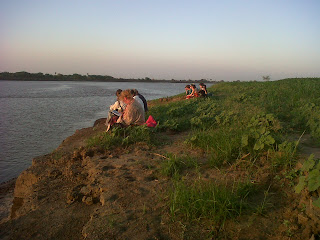
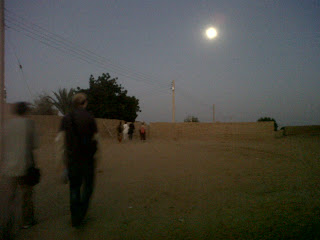
On our third day we walked to the Nile through the village’s farmland.  It was a lovely walk, refreshingly green after the desert conditions of the village itself.  It felt almost like going on a Ramblers walk in England. Rami took us to a part of the Nile where it is possible to swim, although there was a strong undertow.  The water is very shallow, even quite far out.  It was also surprisingly cool so it was a very refreshing dip.  By the time we walked back it was dusk.  The perfect end to our stay.
Yesterday we set off back to Khartoum, stopping in Shendi for a fish breakfast.  In true Sudanese style, throughout our stay Rami has paid for all eleven of us, again and again, refusing to let us contribute in spite of the fact that we know he is on quite a low wage and has to contribute money to family members.  We all signed a card in gratitude for his extreme generosity. 
On our return to Khartoum, all the shops were still shut and there were far fewer street traders than usual.  We are all very glad that we were able to join in and be a part of a Sudanese Eid celebration.

Tuesday, 23 October 2012

23rd October 2012 – visit to the Ministry of Education

A new volunteer, Kate, has arrived in Sudan who will be partnered with me in Ed Damer.  Much to my relief SVP has helped to find a much more suitable place for the two of us to live in, courtesy of Griselda Tayib, who I have mentioned in a previous post.  This still needs to be formally agreed by the Ministry of Education.  Separate accommodation will make a huge difference to our day to day lives in Ed Damer. 

Yesterday evening Kate and I were told that we should go to the Ministry of Education today to discuss our placement and accommodation at Ed Damer.  After meeting with Aifa, the original brains behind SVP sending volunteers to schools (they had previously been to universities only), she took us upstairs to ‘meet the Minister of Education’.  The Minister was at a meeting of the Council of Ministers but was due back shortly.  While we waited we were taken to a conference room where a comedy act was in progress on stage, accompanied by Sudanese music.  Kate and I were very bemused – it seemed such an unlikely thing to find in a government ministry.  Following the music and comedy, there were speeches and a presentation to a young man called Ahmed who has serious physical disabilities.  He was being honoured for his achievements in gaining a Masters degree and for his assistance to other disabled students.  Once the presentation was over, the music started again.  Everyone got up and danced in the Sudanese style, with plenty of finger clicking, clapping and linking of arms.  We all joined in.  It was lovely to see the Ministry’s recognition of his achievements done in such a human way.  No cold commendation or medal, but a real Sudanese-style knees up.  Ahmed and his mother looked completely over the moon. 
Aifa then took us to the Minister’s very plush suite of offices to await her arrival.  We waited in the boardroom.  While we were waiting a group of people from UNICEF arrived to set up a presentation for the Minister.  Kate and I both felt very small and insignificant by contrast to this vast NGO.  However when the Minister arrived, and before she did anything else, she took us into a smaller office and talked to us very enthusiastically about the importance of our work in helping Sudanese teachers learn modern teaching methods and students to improve their spoken English.  As with Ahmed’s presentation, the personal touch was very clear.  The Minister even said that if we faced any difficulties she would be happy to speak directly to people!  The whole experience made a refreshing change from the multi-layer bureaucracy we all know so well in the UK.

Friday, 19 October 2012

19th October – Nuba wrestling

Today, I went with Becca (the SVP coordinator) and her sister to see Nuba wrestling.  The Nuba people live in the Nuba Mountains in the south of the Republic of Sudan (not South Sudan).  Wrestling is a very important part of their culture. 

Drummer
Wrestling
We arrived early enough to have proper seats close to the arena.  A solitary drummer walked around the arena keeping a steady beat, which he continued throughout the event.  There were a lot of contestants, all wearing shorts and t-shirts.  According to my guidebook, in the Nuba Mountains the wrestlers would be semi-naked, but dress in Khartoum to comply with Islamic expectations.  At the start, they all processed around the arena, before competing against each other.  The aim is to knock your opponent to the ground.  The wrestlers start very cautiously, circling and dusting themselves with sand from the ground until they see an opportunity to latch onto the other.  There was clearly a lot of skill involved so it was quite fascinating to watch.  Some of the bouts ended with very dramatic flinging of opponents to the ground, and standing ovations from the audience. 
I hadn’t put Nuba wrestling very high in my priority list of ‘things to see’ because I found it hard to imagine enjoying any form of wrestling.  How wrong I was.